The BRAT album - a recession indicator
How was the BRAT Album received by Australian audiences?
Global media consists of both global platforms that "are in the business of world building" (Muldoon, 2022) and local factors that provide context for how media is understood in a particular setting, they are in the business of culture building. As media globalisation aches for connectivity, it is critical that we understand "the politics of connectivity" including who benefits from digital platforms and what are their limitations (Mjøs, 2022). Global dissemination has made way for the cross-pollination of genres (Li, 2025) and the influence of synthesis of sounds as well as the participatory culture of the internet audience in co-creating value within media industries (Jenkins, 2006). As digital platforms pave the way for the globalisation of music that's impact is measured historically and economically in Australia, we must account for the political relevance of rentier relations and why certain media is being received so generously. This case study will investigate how the music industry is impacted by economic, technological, historical and cultural factors to determine how genres of music are received and become viral in Australia. The specific focus will be on the June 2024 release of 'BRAT', the album from British pop star Charli XCX. BRAT debuted at No 1. on the ARIA Album Charts and its synthesis of club culture, female rage, girlhood, family relationships and vulnerability became a visual identity in Australian nightlife and fashion showcasing glocalisation in action.
Partying, Online, and Broke: BRAT as Recession Icon

The album cover of BRAT by British pop star Charli XCX, released 7 June 2024, the beginning of summer in England. In June 2024, Australia's economy experienced subdued growth.
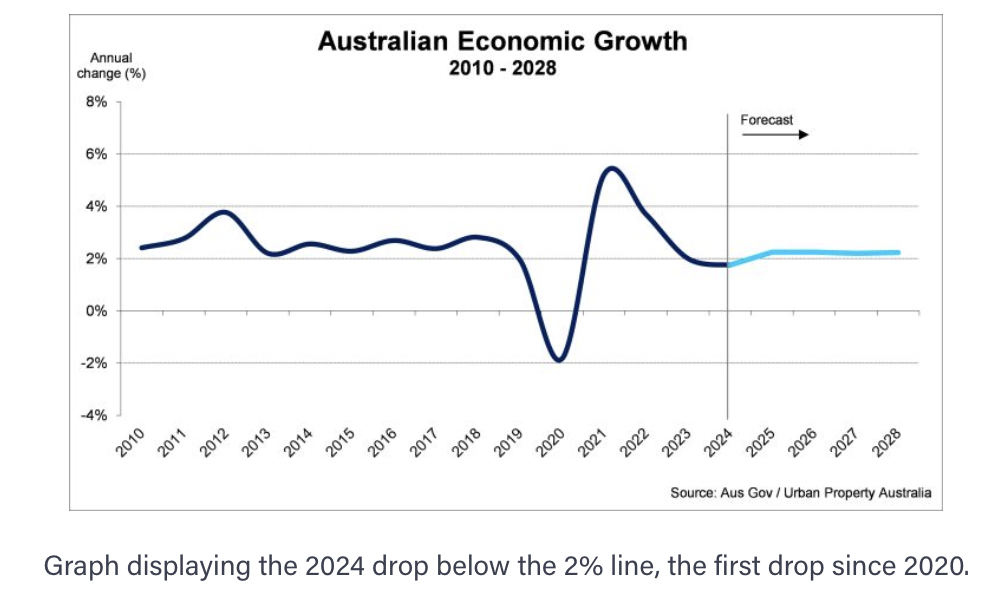
When the album was released on 7 June 2024, Australia's economy was experiencing subdued growth, the GPA rising only 0.2% marking the slowest annual growth since the 1991-2 recession and a lack of household spending due to the cost of living crisis was a significant factor. (ABOS, 2024). As a result 'recession pop' is seeing a re-emergence which is chaotic, raw, party music that offers escapism from the harsh reality of scarcity glamorizing indulgence in small luxuries.
“The resurgence of recession pop that we’re seeing right now, it reflects young people specifically, their societal struggles, their distrust of corporations and the sort of economy that they’ve inherited in many ways”
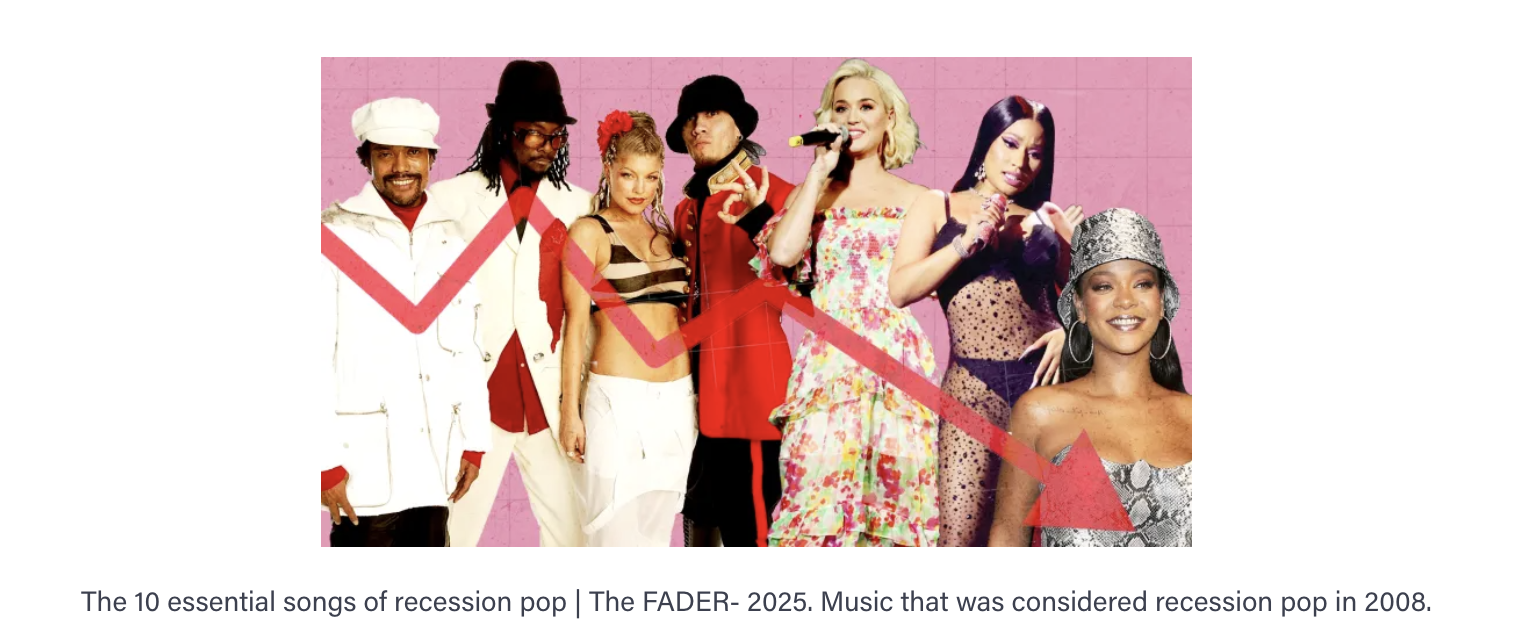
The 'Carrie Bradshaw-esque' BRAT album debuted at a time where the Australia consumer price index rose 1.0% in the June quarter 2024 meaning prices were higher for basic good such as fuel and produce (ABOS, 2024). Indicating audiences were prioritising free or low cost media options such as music available on YouTube and Spotify for free. The BRAT album and Charli XCX as a DIY MySpace artist draws on a linege of free, DIY, underground rave scene music that provided an ability to speak to a young people navigating late capitalism with little financial power (Bennett, 2018).
Hot Girls in Crisis: The Original Brats- 150
The BRAT Album designs the archetype of the 'It Girl' as "wearing last night's makeup", "anorexic", "fucked up but she's still in Vogue", "party girl" and "New York City's darling" with club and cocaine connotations in her song "Mean girls".
"Im your favourite reference baby"- Charli XCX in song 360"
The gorgeous party girl in crisis is a significant icon in Australian pop culture, it can be identified in cultural figures referenced throughout the album.
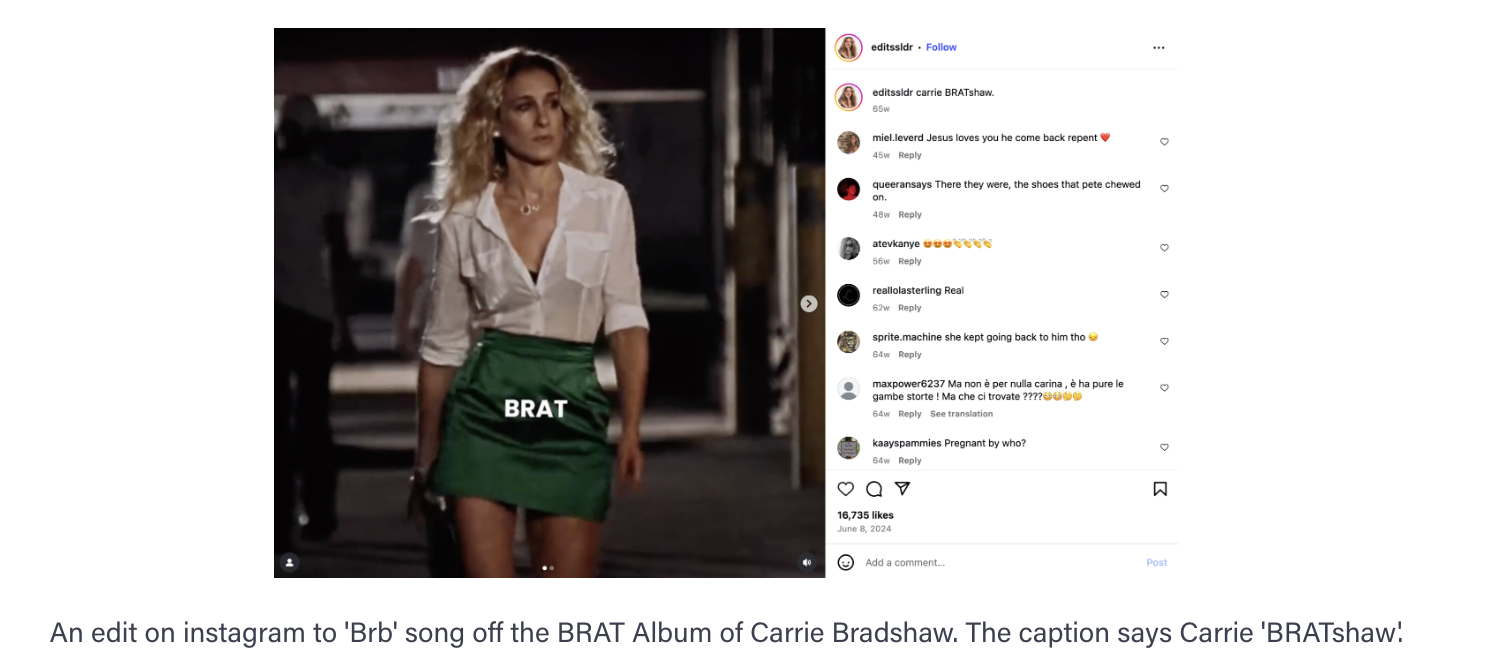
BRAT's rebellious nature resists hegemony femininity that seeks to enforce customs of female discipline (Lewis, 2017), through soft power influence in it's messy and unapologetic aura, similar to Carrie Bradshaw's sexual liberation, this is being recognised by Gen Z editors online
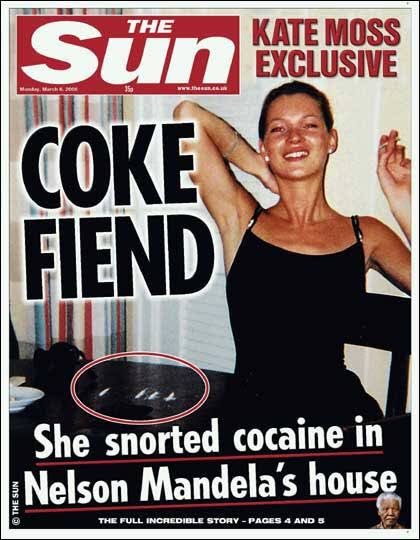
The drug culture portrayed in the album in songs such as '360' references famous party girls such as Kate Moss.
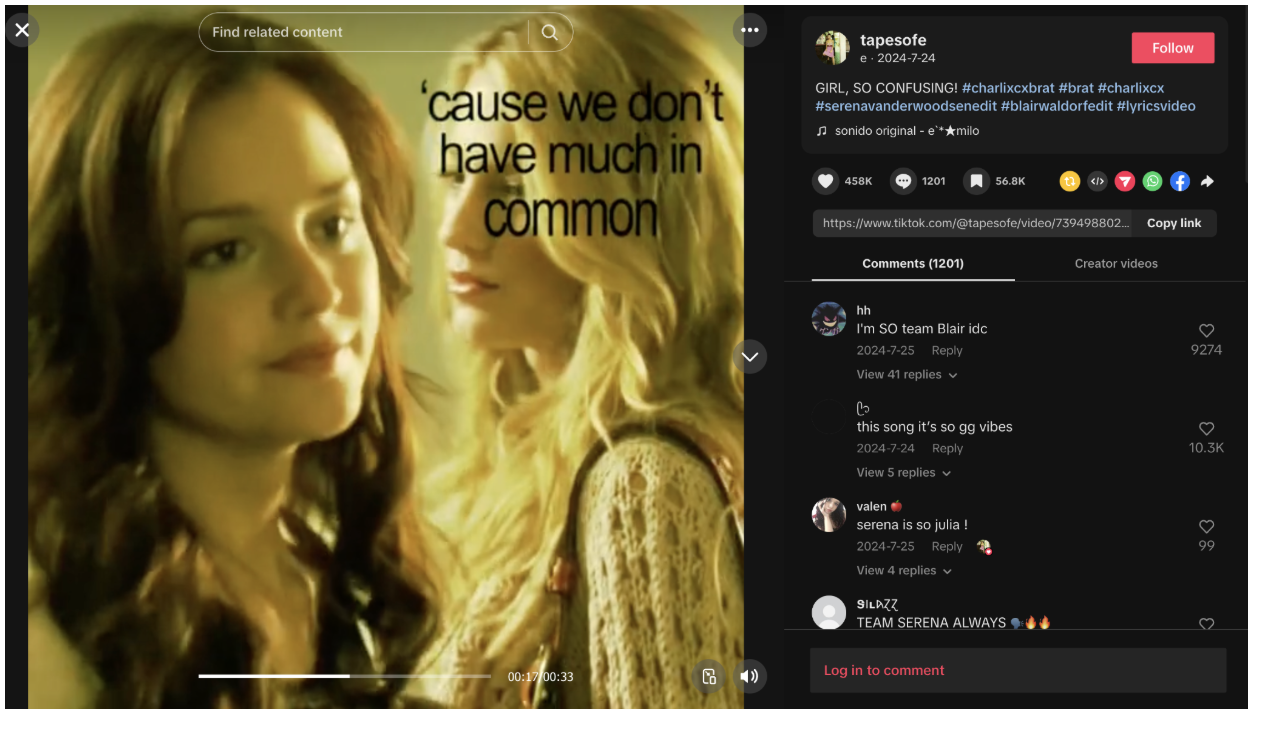
Many edits have been made on TikTok and Instagram of the 2007 Gossip Girl show main characters Blair and Serena to the song 'Girl so confusing' that depicts difficult female friendships.

Mischa Barton struggling with body image playing a Party Girl in Marissa Cooper on The OC and reportedly in real-life. 2003-2007
BRAT achieved cultural resonance as a system of institutional endorsement (e.g., radio features on Triple J), embodied performance (DIY music), nostalgic comfort to create a taste logic that made BRAT feel participarty and collective (Geary, 2020). The taste shaped by the cultural time of 2003 made Mischa Barton and Marissa Cooper the party girls with tragic storylines.
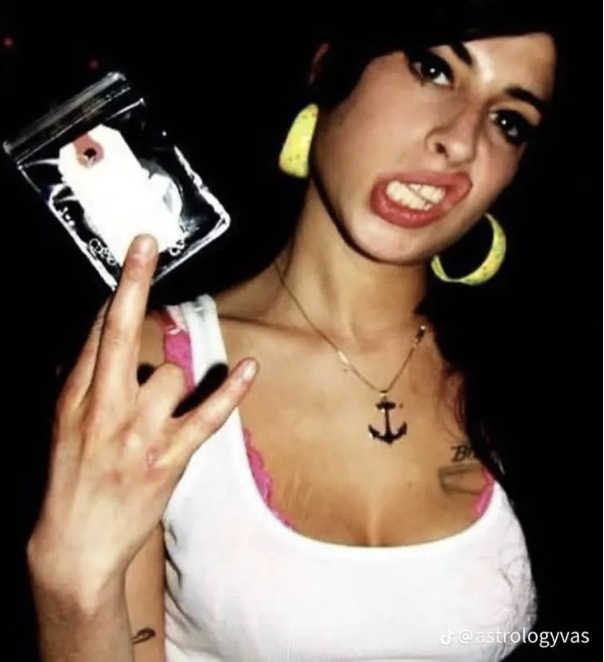
Amy Winehouse 2006- another cool and sexy Hollywood beauty lost to tragedy
'B2b' has a similar connotation to 'Back to Black' as does Charli XCX to Amy Winehouse, "she blasts a selection of Y2K EDM-inspired tracks from Brat, then stops to lean back in her chair delighted, smoke a cigarette and swig a red Coke" describes Rolling Stones interviewer Hannah Ewen (about Charli XCX).
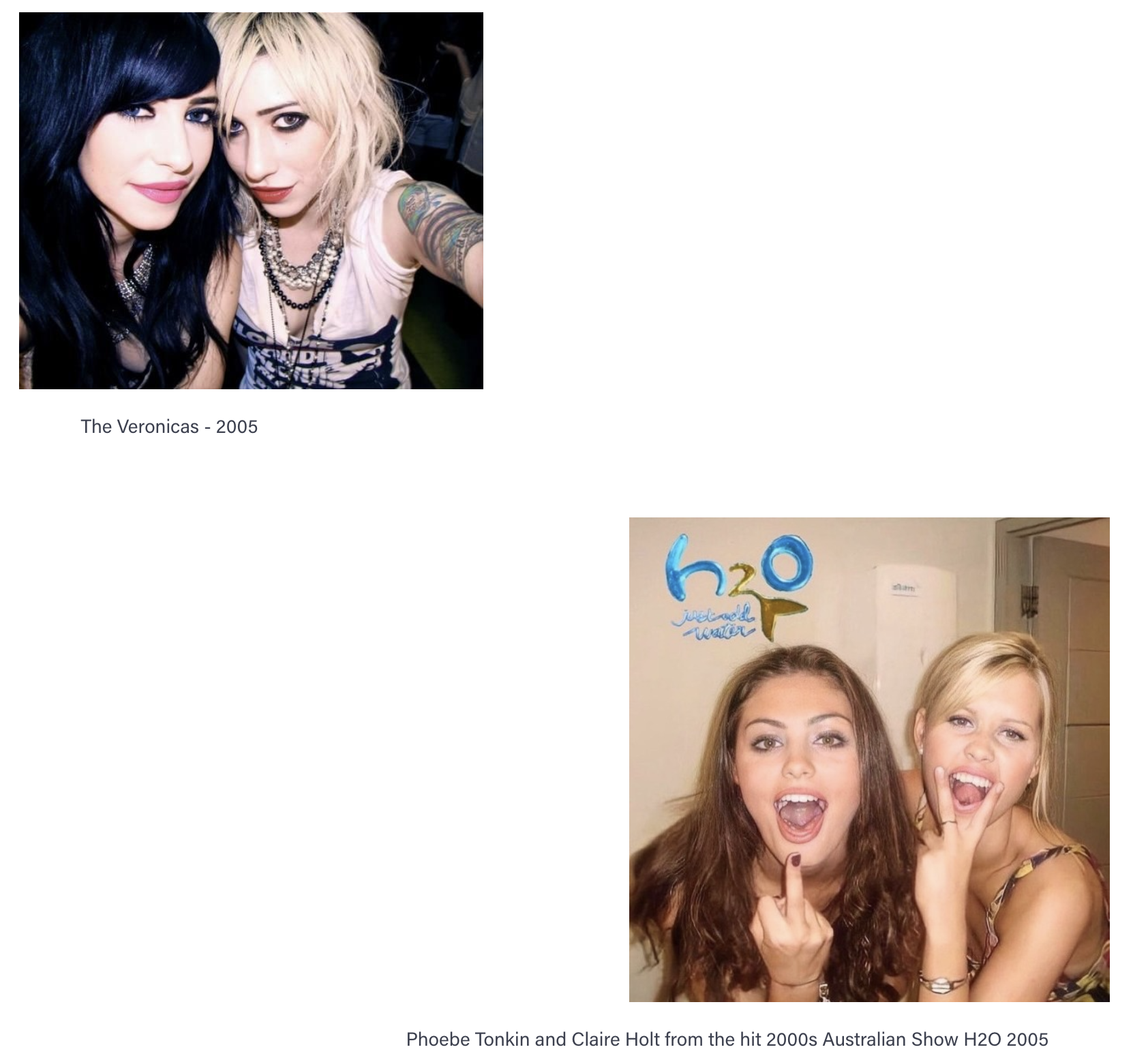
These Australian party 'It Girls' display the resonance in this taste culture in the 2000s, the aesthetic appropriation of the y2k house music and tragic beauty tropes resonates in Australia. The hybridity of genres translates global hyperpop through local club infrastructure that create a taste for digital connection and escape (Peng, 2023)
#BRAT: Brat Summer
Digital commodification is evident in BRAT where feelings and aesthetics such as chaos and brattiness become monteizable content, social media trends including 'brat summer' involving clubbing and making questionable decisions and 'the apple dance' are emotional and aesthetic expression being commodified digitally as user-generated content (Mjøs, 2022). This circulation becomes an instrument of power by enforcing participatory and partying culture as the current taste within economic crisis (Levine & Newman, 2014).
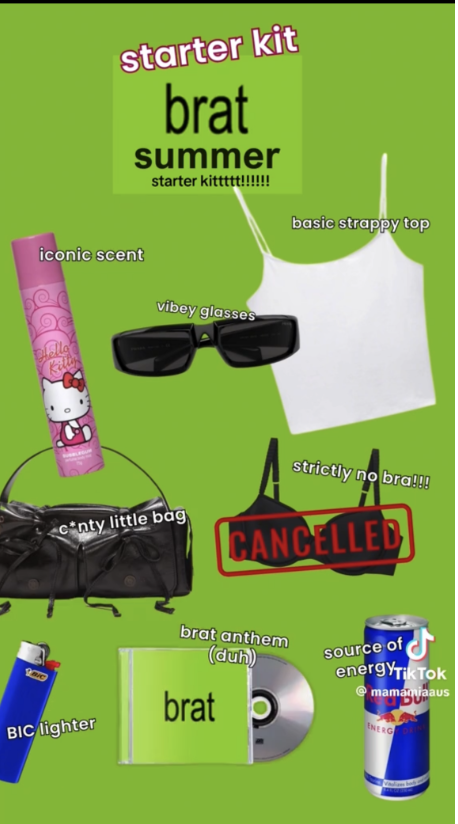
BRAT reached Australian audiences outside of traditional media systems but instead through micro trends such as #BRAT summer that created a cultural movement celebrating dancing in the club, navigating heartbreak, oversharing and feminine chaos as resistance. Charli XCX benefits from this digital distribution to Australia but does produce questions about how BRAT summer may have overshadowed local artists due to algorithmic preference on digital infrastructures, TikTok and Spotify, particularly with Charli XCX headlining Australian festival Laneway in Feb 2025 instead of an Australian artist (Mjøs, 2022).
The personalisation use of data for audience segmentation on platforms such as Spotify and TikTok served BRAT tracks to users that showed the expression of hyperpop, rave music, y2k trends and sad-girl music, and off of this using statistical lookalikes it could present this music to more users (Turow, 2014). This is especially relevant to late-capitalist pop as a recession indicator where artist success can depend upon aligning with aesthetic and mood which is what ignites the data used in this personalisation process.
Micro trends such as the dance to 'Apple' from the album which was performed all over TikTok by users such as at Coachella, Alex Consani, Chappel Roan, on The Today Show, Jetstar Australia and at many BRAT concerts completely choreographed on TikTok. This displays producer-consumer covergence shifting patterns and enforcing the fact that 'everyone' can be a producer, further celebrating the participatory culture (Iosifidis, 2011).
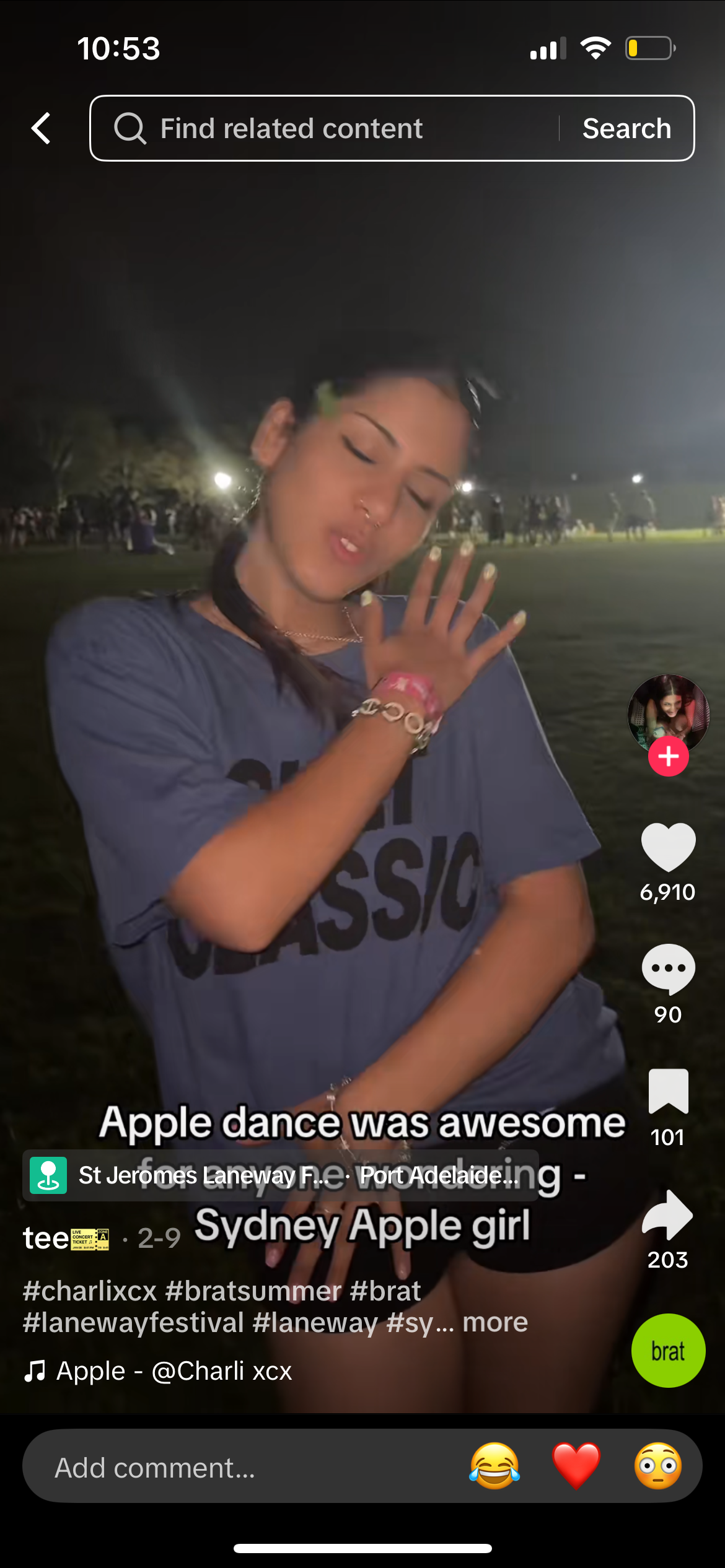
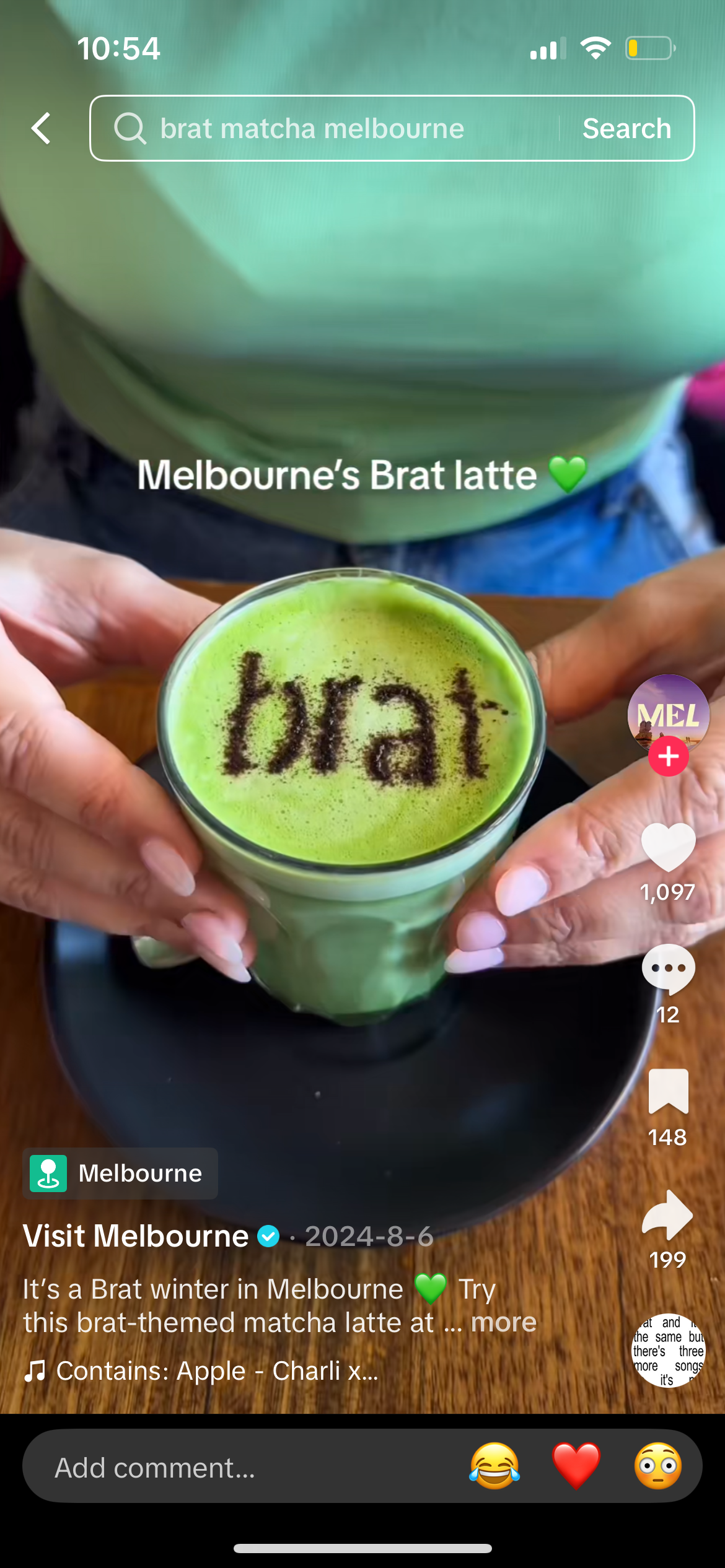
Mass-meditated visual culture of the green BRAT colour, low-resolution party photos and y2k fashion are becoming instantaneously recognisable and iconic online and offline in Australia inviting digital remix culture where fans utilise this to produce meaning (Messaris, 2001).
The cultural significance of the BRAT album is undeniable due to technology that has provided streaming services utilising audience segmentation to enforce the 'correct audience' to invite digital remix culture of edits and trend. Such edits often involve culturally significant icons that the song lyrics and DIY house beats relate to including Lindsey Lohan, Serena Van-der-Wooden and Marissa Cooper. The participatory culture of the internet audience has been crucial to this album enormous success.
References
Arnold, A. (2024). Are we headed into a recession? Charli XCX says yes. The Saint. https://www.thesaint.scot/post/are-we-headed-into-a-recession-charli-xcx-says-yes
Australian Bureau of Statistics. (2024). Australian National Accounts: National Income, Expenditure and Product, June 2024. Australian Bureau of Statistics. https://www.abs.gov.au/statistics/economy/national-accounts/australian-national-accounts-national-income-expenditure-and-product/jun-2024
Bennett, A. (2018). Youth, music and DIY careers. Creative Labour and Music, 40(3), 280–291. https://doi.org/10.1177/1749975518765858
Bermeo, N., & Pontusson, J. (Eds.). (2014). Coping with crisis: Government reactions to the Great Recession. Russell Sage Foundation
Dalla Riva, C., & Page, W. (2025). ‘Glocalisation’ of Music Streaming within and across Europe. The London School of Economics and Political Science.
Enhuber, M. (2025, March 18). TikTokification: How TikTok’s prosumer culture is disrupting the music industry. The Creative Conversation. https://thecreativeconversation.wordpress.com/2025/03/18/tiktokification-how-tiktoks-prosumer-culture-is-disrupting-the-music-industry-c22032730/?utm_source=chatgpt.com
Ewens, H. (2024, May 20). Charli XCX isn’t holding back. Rolling Stone Australia. https://au.rollingstone.com/music/music-features/charli-xcx-brat-sophie-motherhood-interview-60094/
Gebesmair, A. (2022). The global music business and the globalization of culture. In S. Frith, L. Brennan, & B. Strauss (Eds.), The Oxford handbook of global popular music (pp. 47–88). Oxford University Press. https://doi.org/10.1093/oxfordhb/9780190081379.013.3
Geary, P. (2020). The production of taste: ecologies, intersections, implications. Studies in Theatre and Performance, 40(3), 280–291. https://doi.org/10.1080/14682761.2020.1807193
Havens, L. (2024, December 16). How Charli XCX kept the ‘brat’ party going all year. Billboard Canada. https://ca.billboard.com/music/pop/charli-xcx-brat-album-rollout-remix-strategy-1235854293/
Hesmondhalgh, D. (1998). Globalisation and cultural imperialism: A case study of the music industry. In Globalisation and the Third World (pp. 22–43). Routledge. https://doi.org/10.4324/9780203347164-13
Holt, J., & Perren, A. (2019). Media Industries: A Decade in Review. In T. Flew (Editor), Making Media (pp. 31–44). Amsterdam University Press. https://www-degruyterbrill-com.ezproxy.newcastle.edu.au/document/doi/10.1515/9789048540150-002/html
Iosifidis, P. (2011). Global media and communication policy. International Journal of Communication. Palgrave Macmillan.
Krüger, S., & Moy, R. (Eds.). (2015). Popscript Volume II: Graduate research in popular music studies. Lulu Press. https://d1wqtxts1xzle7.cloudfront.net/37734217/Popscript_Volume_II__final___revisedIntro____embeddedfonts-libre.pdf
Levine, J. R. (2017). The paradox of community power: Cultural processes and elite authority in participatory governance. Social Forces, 95(3), 1155–1179. https://doi.org/10.1093/sf/sow098
Li, P. (2025). Popular music in an age of globalization: Cultural exchange through media platforms. Humanities and Social Sciences Communications, 12(1306). https://doi.org/10.1057/s41599-025-05602-4
Lotz, A. D. (2017). Industry. In L. Ouellette & J. Gray (Eds.), Keywords for Media Studies. New York University Press. (pp. 102–105) https://doi.org/10.18574/nyu/9781479817474.003.0034
Messaris, P. (2001). Visual culture. In J. Lull. Culture in the communication age. Routledge. (pp. 14–33) https://doi.org/10.4324/9780203136188-14
Mjøs, O. (2022). The popularization and consolidation of the global online environment: The internet, social media, and search engines. In An introduction to global media for the twenty‑first century (pp. 47–88). Bloomsbury Publishing.
O’Brien, L. (2025, February 12). Digital music revolution: How the internet is redefining music consumption and influencing aspiring musicians. Music Science Life. https://www.musicsciencelife.com/articles/digital-music-revolution-internet-influencing-musicians/
Peng, H.-P. (2023). Creative Genre Matters: Trendy Drama and the Rise of the East Asian Global Media Market. Television & New Media, 24(5), 549–558. https://doi.org/10.1177/15274764231171069
Wong, A. (2024, July 21). Recession pop explained: How music collides with economic trends. CNBC. https://www.cnbc.com/2024/07/21/recession-pop-explained-how-music-collides-with-economic-trends.html
Sterenberg, C. (2024). Globalisation vs. glocalisation: Exploring streaming, policy, and progress in the Australian music industry. Master's thesis, Berklee College of Music. https://remix.berklee.edu/graduate-studies-global-entertainment-business/366
Turow, J. (2014). Media today: Mass communication in a converging world. (Eigth Edition) Routledge